
DevOps in Software Development: Lifecycle Phases, CI/CD Pipelines & Automation Best Practices(2026)


In today’s digital economy, software delivery has shifted from periodic releases to continuous evolution. Organizations are expected to deliver new features rapidly while maintaining reliability, security, and performance across increasingly complex cloud and distributed environments. Traditional development models often struggle to meet these expectations, leading to slow release cycles, production issues, and rising operational costs.
This is where DevOps in software development has become a critical capability rather than a technical preference. By integrating development and operations into a unified, automated workflow, DevOps enables organizations to build, test, deploy, and operate software efficiently at scale. Practices such as continuous integration and delivery (CI/CD), Infrastructure as Code, automated testing, and real-time monitoring transform software delivery from a manual, high-risk process into a predictable and resilient system.
For organization building custom software, scaling SaaS platforms, or modernising legacy systems, DevOps provides the foundation for speed, stability, and long-term success. It enables teams to release updates frequently, respond quickly to changing requirements, and maintain system reliability as applications grow in complexity.
This guide examines the DevOps lifecycle, implementation strategies, tools, challenges, and measurable business benefits essential for modern software delivery.
Key Takeaways:- DevOps in software development integrates development and operations into a unified, automated delivery workflow.
- CI/CD pipelines automate build, testing, and deployment, reducing manual errors and accelerating release cycles.
- Infrastructure as Code (IaC) ensures environment consistency across development, staging, and production.
- Continuous monitoring and observability reduce recovery time and improve reliability.
- High-performing DevOps teams measure success using DORA metrics such as deployment frequency and lead time for changes.
For an organization delivering custom software, DevOps is not just a technical improvement — it is a structural advantage that enables faster innovation with controlled operational risk.
What is DevOps in Software Development?
DevOps in software development is a collaborative approach that integrates development (Dev) and IT operations (Ops) to simplify the entire software delivery lifecycle. Instead of treating coding, testing, deployment, and infrastructure management as separate activities handled by different teams, DevOps aligns them into a continuous workflow designed to deliver reliable software quickly and efficiently.
The primary objective of DevOps is to shorten the time between writing code and delivering it to users while maintaining stability, security, and quality. Automation plays a central role in achieving this goal. Continuous integration and continuous delivery (CI/CD) pipelines ensure that code changes are automatically built, tested, and deployed, reducing manual effort and minimizing errors. Infrastructure as Code (IaC) enables consistent environment provisioning, while monitoring and observability tools provide real-time visibility into system performance.
Beyond tools and processes, DevOps represents a cultural shift toward shared ownership and cross-functional collaboration. Modern software development teams increasingly operate as integrated units responsible for the entire application lifecycle, from initial design to production operations. This approach reduces delays, improves software quality, and enables organizations to respond quickly to evolving business requirements.
Why DevOps Is Critical for Modern Custom Software Projects?
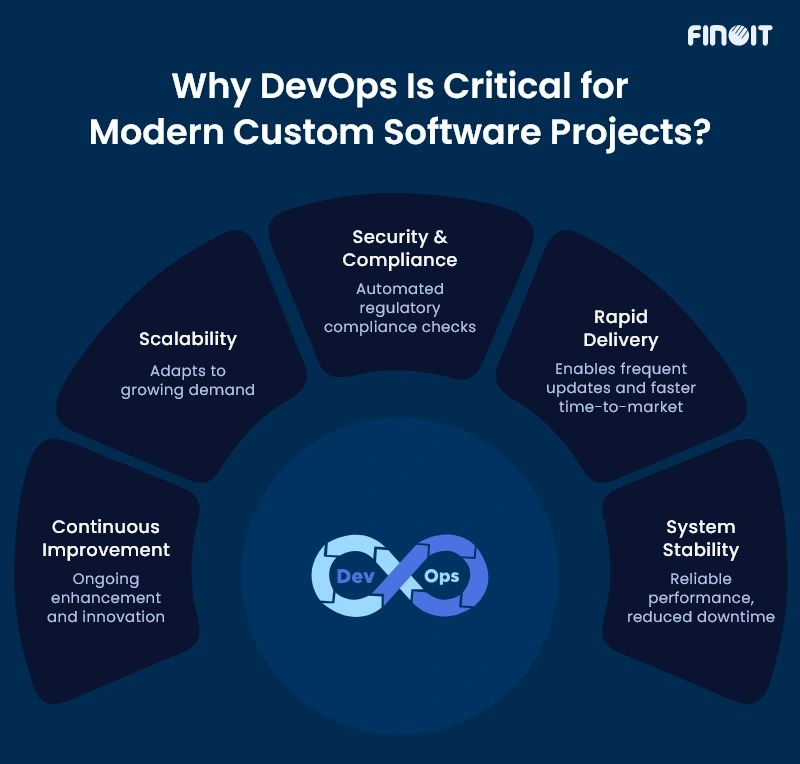
Modern custom software projects operate in complex environments that require rapid delivery, high reliability, and continuous adaptation. Unlike off-the-shelf solutions, custom applications must support unique workflows, integrate with existing systems, and scale as business needs evolve. Without a robust delivery framework, organizations often face delayed releases, unstable deployments, and increasing operational overhead.
Faster and More Reliable Releases
Traditional release processes rely heavily on manual steps, making deployments slow and error-prone. DevOps introduces automated CI/CD pipelines that continuously build, test, and deploy code changes. This enables teams to deliver updates frequently while reducing the risk of production failures. As a result, software improvements reach users faster without compromising stability.
Improved Collaboration Across Teams
Custom software development typically involves multiple stakeholders, including developers, operations engineers, QA teams, and business units. DevOps promotes cross-functional collaboration by aligning these roles around shared goals and responsibilities. This reduces communication gaps, accelerates decision-making, and improves overall project efficiency.
Scalability and Infrastructure Consistency
As the organization grow, custom applications must handle increasing workloads and expanding user bases. DevOps practices such as Infrastructure as Code (IaC) and containerization allow environments to be provisioned consistently and scaled on demand. This ensures that development, testing, and production systems behave predictably, minimising configuration issues.
Enhanced Stability and System Reliability
Continuous monitoring and automated feedback mechanisms enable teams to detect performance issues and failures early. Instead of reacting to outages after they occur, organizations can proactively address problems, reducing downtime and maintaining service quality for end users.
Integrated Security and Compliance
Security and regulatory requirements are critical for enterprise applications. DevOps integrates automated testing, vulnerability scanning, and compliance checks into the delivery pipeline, often referred to as DevSecOps. This approach helps identify risks early and ensures that security controls evolve alongside the software.
Continuous Improvement and Business Agility
DevOps transforms software delivery into an ongoing process rather than a one-time project. Frequent releases, real-time feedback, and data-driven insights enable the organization to adapt quickly to changing market demands and customer expectations. This continuous improvement cycle supports long-term innovation and competitive advantage.
DevOps Lifecycle Phases Explained
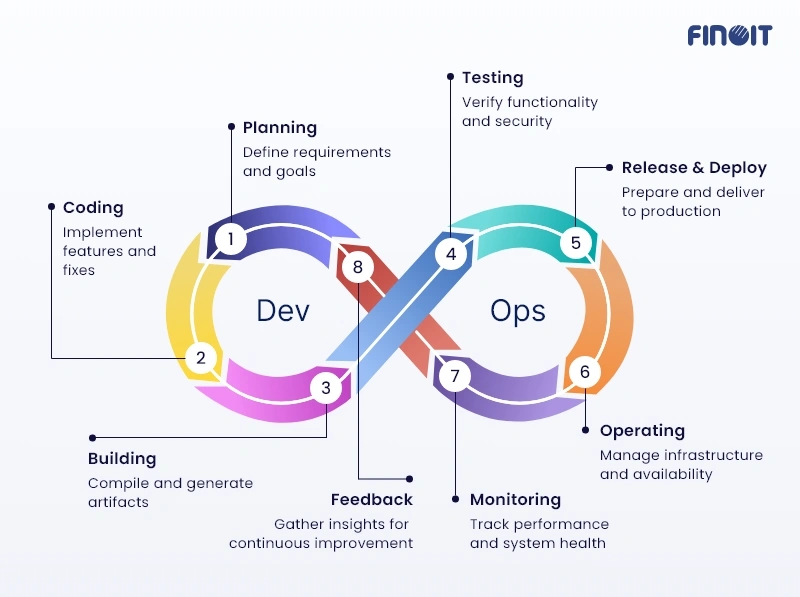
The DevOps lifecycle phases represent a continuous and iterative approach to delivering reliable software efficiently. Unlike traditional development models that treat development and operations as separate activities, DevOps in software development integrates these functions into a unified process that supports rapid delivery, scalability, and stability. Each phase contributes to a continuous loop that enables the organization to build, deploy, operate, and improve applications effectively.
1. Planning
The lifecycle begins with planning, where business requirements, technical goals, timelines, and success metrics are defined. For organizations developing custom software, this phase ensures alignment between business objectives and technical execution. Collaboration among stakeholders and the software development team helps establish priorities and reduce downstream risks.
2. Coding
During the coding phase, developers implement features, enhancements, and bug fixes using version control systems. Frequent commits enable continuous integration processes to validate changes early, improving collaboration and code quality.
3. Building
Once code is committed, automated build systems compile the application and generate deployable artifacts. This stage relies heavily on DevOps automation to ensure consistency across environments and eliminate manual errors that can slow delivery.
4. Testing
Testing verifies functionality, performance, and security before release. Automated testing frameworks execute unit, integration, and end-to-end tests to detect defects early. Continuous testing is essential for maintaining reliability in complex custom software solutions.
5. Releasing
In the release phase, validated builds are prepared for deployment. Versioning, approvals, and packaging ensure traceability and compliance. Automated pipelines allow teams to move releases through staging environments efficiently.
6. Deploying
Deployment delivers the application to production environments using controlled strategies such as rolling updates or blue-green deployments. A well-configured CI/CD pipeline ensures deployments are consistent, repeatable, and minimise downtime.
7. Operating
After deployment, the application enters the operational phase, where it must perform reliably under real-world conditions. Operations teams manage infrastructure, availability, and scalability to support growing user demand.
8. Monitoring
Continuous monitoring tracks performance metrics, system health, and user activity. Observability tools provide real-time insights that enable teams to detect anomalies early and respond quickly to incidents.
9. Feedback and Continuous Improvement
Insights gathered during monitoring feed back into planning, creating a continuous improvement loop. This feedback-driven approach allows organization to refine features, optimise performance, and respond to evolving requirements, a hallmark of mature DevOps in software development practices.
DevOps in a Custom Software Project – Real-World Example
A SaaS company developing a multi-tenant analytics platform faced frequent release delays and production instability. Manual deployments and inconsistent environments caused repeated failures and long recovery times.
Before DevOps implementation:
- Releases every 6–8 weeks
- High deployment risk
- Frequent production incidents
- Limited testing automation
After implementing DevOps practices:
- Git-based workflow and version control
- CI/CD pipeline in software development
- Infrastructure as Code for environment consistency
- Automated testing coverage exceeding 80%
- Continuous monitoring and alerting
Results achieved:
- Release frequency increased to multiple deployments per week
- Deployment failures reduced significantly
- Mean Time to Recovery improved from hours to minutes
- Greater confidence in scaling the platform
This example illustrates how DevOps in software development enables organization to deliver complex custom software faster while maintaining reliability and operational stability.
How a CI/CD Pipeline Works in DevOps
A CI/CD pipeline in software development is a core mechanism of DevOps in software development that automates how code moves from development to production. It integrates building, testing, and deployment into a continuous workflow, enabling organizations to deliver software updates rapidly while maintaining stability and quality. Instead of treating releases as large, infrequent events, CI/CD turns delivery into a routine, low-risk process.
Continuous Integration (CI)
Continuous Integration focuses on automatically merging code changes into a shared repository. Developers commit updates frequently, and each commit triggers automated builds and tests. This approach prevents integration conflicts and detects defects early, ensuring the codebase remains stable. Automated validation is critical for maintaining efficiency across the software development team.
Key CI activities include:
- Building the application automatically
- Running unit and integration tests
- Performing quality checks
- Providing immediate feedback to developers
By catching errors early, CI reduces the risk of failures during later stages of delivery.
Continuous Delivery (CD)
Continuous Delivery extends CI by preparing validated code for deployment. After passing automated tests, the software is packaged and deployed to staging or testing environments. At this stage, the application is always in a deployable state, and release to production can occur whenever required.
For organization developing custom software, this enables frequent releases without disrupting system stability.
Continuous Deployment
Continuous Deployment represents the most advanced stage of automation. Once all tests pass, updates are automatically released to production without manual intervention. This approach requires robust testing and monitoring to ensure reliability but enables extremely rapid innovation cycles.
Deployment and Release Automation
Modern pipelines incorporate advanced deployment strategies to minimize risk and downtime, including:
- Blue-green deployments
- Canary releases
- Rolling updates
These techniques rely on DevOps automation to ensure consistent releases across environments.
Monitoring and Feedback
A CI/CD pipeline continues beyond deployment. Monitoring tools track system performance, detect errors, and gather user feedback. This data feeds back into development planning, supporting continuous improvement across the software lifecycle.
CI/CD Pipeline Maturity Model
Not all CI/CD pipelines operate at the same level of sophistication. As organization evolve, their delivery systems typically move through stages of maturity.
| Level | Characteristics |
|---|---|
Basic | Automated builds and unit testing; manual production deployment |
Intermediate | Automated testing, staging deployment, basic monitoring |
Advanced | Automated production deployment, blue-green or canary releases |
Elite | Continuous deployment, automated rollback, integrated security scanning, full observability |
Most organization begin at the basic level and progressively integrate deployment automation, Infrastructure as Code, and observability practices. Maturity is defined less by tool complexity and more by delivery reliability, recovery speed, and confidence in releasing frequently.
Why CI/CD Pipelines Are Essential
A well-designed CI/CD pipeline enables organizations to:
- Deliver features faster
- Reduce deployment risks
- Improve software quality
- Maintain system reliability
- Support scalable operations
For modern applications, particularly complex custom software systems, CI/CD pipelines serve as the operational backbone that allows continuous innovation without sacrificing stability.
DevOps Automation After Code Is Written
After development is complete, the software must pass through several critical stages before reaching users. Without automation, these post-development activities often rely on manual processes, increasing the risk of delays, inconsistencies, and production failures. DevOps automation transforms this phase into a reliable, repeatable workflow that supports continuous delivery.
Automated Build Processes
Traditional build procedures often depended on manual execution and environment-specific configurations, leading to unpredictable outcomes. In a DevOps environment, every code commit triggers automated builds that compile the application, resolve dependencies, and generate deployable artifacts. This ensures consistency across environments and provides immediate feedback if issues occur.
Continuous Testing
Testing shifts from a final step to an ongoing activity throughout the delivery pipeline. Automated unit, integration, performance, and smoke tests validate software quality at each stage. This approach prevents defective code from progressing further and supports rapid release cycles for complex custom software solutions.
Reliable Deployment Processes
Deployment becomes standardised and low risk through automation. Modern pipelines use controlled release strategies such as blue-green deployments, canary releases, and rolling updates to minimize downtime and ensure system stability. These methods allow updates to be introduced gradually and rolled back quickly if problems arise.
Infrastructure as Code (IaC)
Managing environments manually often leads to inconsistencies between development, testing, and production systems. Infrastructure as Code eliminates this issue by defining infrastructure configurations in scripts that can be executed automatically. This ensures that all environments remain consistent, scalable, and reproducible.
Continuous Monitoring and Observability
Monitoring becomes an integral part of the delivery process rather than a reactive activity. Logs, metrics, and distributed traces provide real-time visibility into system performance and user behaviour. Automated alerts enable teams to detect anomalies early and respond before issues escalate.
Feedback-Driven Improvement
Operational insights feed back into development planning, creating a continuous improvement loop. Teams can refine features, address performance bottlenecks, and prioritise enhancements based on real usage data. This iterative approach enables organization to maintain reliability while continuously evolving their applications.
DevOps Best Practices for Custom Software Teams
As delivery systems mature, certain operational patterns consistently distinguish high-performing DevOps teams from those struggling with instability.
- Keep CI Pipelines Fast:
Pipelines that take 40–50 minutes discourage frequent commits. High-performing teams aim for build-and-test cycles under 10 minutes wherever feasible.
- Design Rollback Before Release:
Every deployment strategy should include a tested rollback plan. Confidence in rollback reduces release hesitation.
- Treat Infrastructure Changes Like Code Changes:
Infrastructure updates should pass through version control, review, and testing just like application code.
- Monitor Business Metrics, Not Just System Metrics:
CPU and memory usage matter, but so do API latency, checkout completion rates, and user journeys.
- Release Smaller Changes More Frequently:
Smaller releases reduce risk and simplify root cause analysis when incidents occur.
- Measure Delivery Performance:
Tracking deployment frequency, change failure rate, and recovery time highlights systemic weaknesses and drives measurable improvement.
Infrastructure as Code (IaC) in DevOps
Infrastructure as Code (IaC) is a critical practice in DevOps in software development that enables organization to provision and manage infrastructure through machine-readable configuration files rather than manual setup. By treating infrastructure as software, IaC allows servers, networks, databases, and cloud resources to be deployed automatically, consistently, and at scale.
Automated Infrastructure Provisioning
Traditional infrastructure management involves manual configuration of servers and environments, which is time-consuming and prone to human error. IaC replaces this approach with scripted definitions that automatically create and configure infrastructure. This capability is especially important for organization delivering custom software, where environments must be replicated reliably across development, testing, and production.
Consistency Across Environments
Manual configuration often leads to discrepancies between environments, causing deployment failures and unexpected behaviour. IaC ensures that every environment is created from the same source definitions, eliminating configuration drift and improving reliability.
Version Control and Traceability
Because infrastructure definitions are stored as code, they can be version-controlled alongside application code. Changes can be reviewed, audited, and rolled back if necessary. This improves governance and accountability while supporting collaborative workflows within the software development team.
Scalability for Cloud-Native Systems
Modern applications require infrastructure that can scale dynamically based on demand. IaC integrates with cloud platforms to provision resources automatically, enabling organization to expand capacity quickly without manual intervention.
Integration with DevOps Automation
IaC plays a central role in DevOps automation, allowing infrastructure provisioning to be integrated into CI/CD workflows. This ensures that both application updates and infrastructure changes are deployed in a coordinated, repeatable manner.
Common IaC Tools
Widely used tools for Infrastructure as Code include:
- Terraform
- AWS CloudFormation
- Azure Resource Manager
- Ansible
- Pulumi
These tools enable organization to manage complex infrastructure efficiently while supporting rapid delivery cycles.
Why IaC Is Essential for Modern Software Delivery
Infrastructure as Code transforms infrastructure management into a predictable and scalable process. By reducing manual effort, eliminating inconsistencies, and enabling automated provisioning, IaC supports reliable deployments and long-term system stability, key goals of mature DevOps in software development practices.
DevOps Tools Used by Modern Software Development Teams
Modern DevOps in software development relies on a comprehensive ecosystem of tools that support every stage of the delivery lifecycle, from planning and coding to deployment and monitoring. These DevOps tools enable organization to implement DevOps automation, accelerate release cycles, and maintain reliability across complex custom software systems. A well-integrated toolchain is essential for successful DevOps implementation and delivery at scale.
Version Control Systems
Version control platforms form the foundation of collaboration for any software development team. They allow teams to manage source code, track changes, and coordinate development activities across distributed environments, a prerequisite for effective DevOps for custom software projects.
Common tools include:
- Git
- GitHub
- GitLab
- Bitbucket
These platforms support branching strategies, code reviews, and integration with automated pipelines.
CI/CD and Build Automation Tools
CI/CD tools automate the process of building, testing, and deploying applications. A robust CI/CD pipeline in software development ensures that code changes move efficiently through validation stages, reducing manual effort and deployment risks. These tools are central to scalable DevOps automation and continuous delivery.
Popular solutions include:
- Jenkins
- GitHub Actions
- GitLab CI/CD
- CircleCI
- Azure DevOps
Testing Tools
Automated testing tools ensure that software meets functional, performance, and security requirements before deployment. Continuous testing supports rapid release cycles while maintaining quality, which is especially critical for enterprise-grade custom software applications.
Examples include:
- Selenium for functional testing
- JUnit and TestNG for unit testing
- Pytest for Python applications
- Postman for API testing
Testing tools integrate directly with CI/CD workflows and support the validation stages defined in DevOps lifecycle phases.
Containerization and Orchestration Tools
Container technologies package applications and dependencies into portable units that run consistently across environments. Orchestration platforms manage these containers at scale, enabling reliable deployment of cloud-native systems.
Key technologies include:
- Docker for containerization
- Kubernetes for orchestration
These tools help organizations scale applications efficiently while maintaining operational stability.
Infrastructure as Code Tools
Infrastructure as Code (IaC) tools automate provisioning and management of infrastructure, ensuring consistent environments across development, staging, and production. IaC is a cornerstone of modern DevOps implementation because it eliminates configuration drift and enables repeatable deployments.
Common IaC solutions include:
- Terraform
- AWS CloudFormation
- Azure Resource Manager
- Pulumi
Monitoring and Observability Tools
Monitoring tools provide visibility into system health, performance, and user behaviour. Observability solutions collect logs, metrics, and traces to detect anomalies early and support proactive maintenance.
Widely used platforms include:
- Prometheus and Grafana
- Datadog
- New Relic
- Splunk
- ELK Stack
Continuous monitoring supports the operational stages of the DevOps lifecycle phases and enables ongoing optimisation.
Incident Management Tools
When failures occur, incident management tools coordinate response efforts and minimise downtime. These platforms ensure rapid communication across teams and structured resolution of critical issues.
Examples include:
- PagerDuty
- Opsgenie
- ServiceNow
Why Tool Integration Matters
A cohesive DevOps toolchain integrates development, testing, deployment, and operations into a unified workflow. This integration enables organization to deliver reliable software faster, reduce operational risks, and maintain high availability for mission-critical systems.
For organization seeking professional DevOps services, selecting and integrating the right tools is a crucial step toward building scalable, resilient, and efficient delivery pipelines.
Common DevOps Implementation Challenges
Implementing DevOps in software development requires significant changes across technology, processes, and organizational culture. While the benefits are substantial, organization often encounter several challenges during adoption that can hinder progress if not addressed proactively.
Integration and Deployment Complexity
Moving applications into production environments requires seamless integration with existing systems, infrastructure, and workflows. Organizations lacking automated delivery pipelines often rely on manual deployment processes, which increase the likelihood of errors, delays, and service disruptions. Establishing a reliable CI/CD pipeline in software development is essential to simplify releases and maintain consistency.
Cultural and Organizational Barriers
DevOps is not solely a technical transformation; it also requires a shift in mindset. Traditional structures separate development, operations, and management functions, creating silos that slow collaboration. Successful adoption of DevOps for custom software initiatives depends on fostering shared ownership, transparency, and alignment across teams.
Monitoring and Feedback Limitations
Once software is deployed, continuous monitoring is essential for maintaining reliability and performance. Many organizations lack mature observability practices, including comprehensive logging, metrics collection, and alerting systems. Insufficient visibility can delay issue detection and prolong recovery times during incidents.
Skill Gaps and Training Requirements
DevOps introduces new responsibilities, including cloud infrastructure management, automation scripting, and Infrastructure as Code practices. Teams without adequate training may struggle to implement these capabilities effectively. Addressing skill gaps through structured training and hiring is critical for successful DevOps implementation.
Security and Compliance Constraints
Organizations operating in regulated industries must adhere to strict security and compliance requirements. Integrating security checks into automated pipelines, often referred to as DevSecOps, can be complex but is necessary to prevent vulnerabilities and ensure regulatory compliance. Without embedded security practices, releases may be delayed due to audits or remediation efforts.
Common DevOps Mistakes That Slow Teams Down
Even well-intentioned DevOps initiatives can stall when structural missteps occur.
- Treating DevOps as a Tooling Project Installing CI tools or container platforms does not automatically create DevOps maturity.
- Over-Automating Too Early Complex automation before stabilising core workflows often creates fragile pipelines.
- Ignoring Observability Deploying frequently without proper monitoring increases operational risk.
- Long-Running CI Pipelines Delayed feedback discourages frequent integration and increases merge conflicts.
- No Clear Ownership Model Unclear production ownership leads to slower incident response and accountability gaps.
- Failing to Track Performance Metrics Without measurable indicators like DORA metrics, improvement becomes guesswork.
Avoiding these pitfalls accelerates DevOps maturity and prevents automation from becoming operational complexity.
Why Addressing These Challenges Is Important
Recognizing and mitigating these barriers enables organizations to implement DevOps more effectively and realize its full benefits. Many enterprises adopt structured transformation strategies or engage specialized providers that offer DevOps services to accelerate adoption while minimizing risk.
By proactively addressing technical, cultural, and operational challenges, organizations can build resilient delivery systems and fully leverage the advantages of DevOps in software development.
DevOps vs Traditional Software Development
Traditional software development approaches separate development and operations into distinct phases handled by different teams. While this model worked for slower release cycles in the past, it struggles to meet modern requirements such as rapid updates, high availability, and scalability. DevOps in software development addresses these limitations by integrating development, testing, deployment, and operations into a continuous workflow.
For organizations delivering complex custom software, the choice between traditional models and DevOps directly impacts delivery speed, reliability, and long-term maintainability.
Key Differences Between DevOps and Traditional Models
Traditional development emphasizes sequential processes, where each stage must be completed before the next begins. In contrast, DevOps promotes collaboration, automation, and continuous delivery through integrated workflows supported by DevOps automation and modern tools.
| Traditional Software Development | DevOps Approach |
|---|---|
Manual deployments | Automated deployment via CI/CD pipeline in software development |
Testing occurs late in the cycle | Continuous testing throughout development |
Separate development and operations teams | Cross-functional software development team ownership |
Reactive issue resolution | Proactive monitoring and observability |
Long release cycles (months) | Frequent releases (days or hours) |
Environment inconsistencies | Infrastructure managed through code |
High risk of deployment failure | Controlled, low-risk releases |
Limited feedback loops | Continuous feedback across DevOps lifecycle phases |
Impact on Business Outcomes
Traditional models often lead to slower innovation due to lengthy release cycles and coordination challenges. Deployment failures can result in significant downtime and operational disruptions. DevOps, by contrast, enables organizations to release updates frequently while maintaining system stability.
For enterprises adopting DevOps for custom software, the benefits include faster time to market, improved reliability, and better alignment between technology and business goals.
Scalability and Modern Infrastructure Support
Modern applications operate in cloud-based, distributed environments that require dynamic scaling. Traditional approaches struggle to manage these complexities manually. DevOps practices such as Infrastructure as Code and automated provisioning enable systems to scale efficiently without introducing configuration inconsistencies.
Risk Management and Stability
Contrary to common assumptions, more frequent releases do not increase risk when supported by mature DevOps practices. Automated testing, controlled deployment strategies, and continuous monitoring ensure that issues are detected early and resolved quickly. This structured approach is a key element of successful DevOps implementation.
Why Organization Are Transitioning to DevOps
As digital transformation accelerates, organizations increasingly rely on modern delivery models to remain competitive. Many enterprises engage specialized providers offering DevOps services to modernize legacy workflows and establish scalable delivery pipelines.
By replacing rigid, siloed processes with collaborative and automated workflows, DevOps in software development enables organizations to deliver high-quality applications faster while maintaining reliability and security.
How to Implement DevOps in Your Software Development Team
Implementing DevOps in software development requires a structured transformation of processes, tools, and organizational culture. For organizations building scalable custom software, a phased approach minimizes disruption while enabling sustainable improvements in delivery speed, reliability, and operational efficiency.
Step 1: Assess Current Delivery Processes
Start by evaluating the organization’s existing development and deployment practices. Identify bottlenecks, manual dependencies, release delays, and infrastructure limitations. This assessment establishes a baseline for improvement across the DevOps lifecycle phases and helps define clear transformation goals for successful DevOps implementation.
Step 2: Establish Version Control and Collaborative Workflows
A centralized version control system enables coordinated development across the software development team. Standardized branching strategies, peer reviews, and shared repositories improve collaboration and reduce integration conflicts, forming the foundation for automated delivery.
Step 3: Build a CI/CD Pipeline
Implement a robust CI/CD pipeline in software development to automate code integration, testing, and deployment preparation. Continuous Integration ensures that code changes are validated immediately, while Continuous Delivery keeps the application in a deployable state at all times. This step is essential for scalable DevOps automation.
Step 4: Automate Testing and Deployment
Automated testing ensures software quality throughout development, while deployment automation reduces manual errors and downtime. Controlled release strategies, such as rolling updates or blue-green deployments, allow organizations to deliver updates safely, a key capability for DevOps for custom software initiatives.
Step 5: Implement Infrastructure as Code and Monitoring
Infrastructure should be provisioned programmatically using Infrastructure as Code to maintain consistency across environments. Continuous monitoring and observability tools provide real-time insights into system performance, enabling proactive issue detection and rapid recovery.
Step 6: Integrate Security and Foster DevOps Culture
Security practices must be embedded throughout the delivery pipeline, including automated vulnerability scanning and compliance checks. Equally important is cultivating a culture of collaboration, shared ownership, and continuous improvement to sustain long-term DevOps success.
DevOps Implementation Roadmap (30–60–90 Days)
Adopting DevOps successfully requires incremental change rather than a sudden overhaul.
First 30 Days: Establish the Foundation
- Standardise Git workflows
- Introduce automated builds on every commit
- Implement basic test automation
- Define deployment workflow
- Begin tracking deployment frequency
Next 60 Days: Automate and Standardise
- Automate staging deployments
- Implement Infrastructure as Code
- Add integration and regression testing
- Configure monitoring dashboards
- Define rollback procedures
90 Days and Beyond: Optimise and Scale
- Introduce canary or blue-green deployments
- Integrate security scanning (DevSecOps)
- Track DORA metrics consistently
- Reduce pipeline execution time
DevOps implementation is less about installing tools and more about systemising delivery.
Benefits of DevOps in Custom Software Development
Adopting DevOps in software development delivers significant strategic and operational advantages for organizations building modern applications. For companies developing complex custom software, DevOps enables faster delivery, improved reliability, enhanced collaboration, and greater adaptability to changing business needs. These benefits are driven by automation, continuous integration, and cross-functional teamwork.
1. Faster Time to Market
Automated pipelines cut the time between writing a feature and putting it in front of users. More frequent releases mean faster feedback on what’s working and what isn’t, which makes the next iteration better.
2. Better Team Collaboration
Shared tooling and shared visibility into the pipeline reduce the friction between teams. Fewer handoffs, less ambiguity about who owns what, and faster decision-making when problems arise.
3. Higher Quality Software
Continuous testing catches defects earlier. Controlled deployment strategies limit the impact of problems that do make it through. The result is software that’s more reliable and less prone to errors.
4. Greater Agility and Innovation
Organizations that release frequently can experiment. A feature hypothesis can be tested in days rather than quarters. This isn’t just a technical benefit; it changes how product decisions get made.
5. Scalability Without Proportional Overhead
Automated infrastructure provisioning means growth doesn’t require proportional growth in operational effort. Systems scale based on demand, not based on whether someone remembered to provision additional capacity.
6. Measurable Business Outcomes
Reduced operational costs, faster feature delivery, fewer production incidents, better user experience; these are outcomes that organizations consistently report when DevOps practices mature. The investment in tooling and process pays back.
Why DevOps Is Essential for Custom Software Projects
Custom software carries a category of risk that packaged software doesn’t. There are no vendors to call when something breaks. There’s no established community working through the same problems. Every deployment, every incident, and every missed release window belongs to the organization that built the system.
DevOps reduces this risk materially. Automated testing catches more failure modes before production. Controlled deployment strategies limit the blast radius of problems that make it through. Monitoring gives teams the information they need to respond quickly rather than frantically.
Beyond risk management, DevOps enables custom software to evolve at the pace businesses actually require. Requirements change constantly. Integrations need updating. New capabilities become urgent. A delivery process that can ship changes in days gives organizations flexibility that a monthly release cycle cannot.
There’s also a competitive dimension. For organizations where software is a core part of the product, which describes most modern businesses, the speed and reliability of delivery directly affect the product’s quality. Teams that can improve their software continuously hold an advantage over teams that cannot.
DevOps Performance Metrics (DORA)
The DevOps Research and Assessment program studied thousands of software teams over many years to understand what actually predicts delivery performance. They identified four metrics that reliably distinguish high-performing teams from lower-performing ones.
- Deployment Frequency:
How often do you release to production? Elite teams deploy multiple times per day. Low performers deploy monthly or less.
- Lead Time for Changes:
How long from code commit to production? Shorter is better. Elite performers measure this in hours. Lower performers measure it in weeks or months.
- Change Failure Rate:
What percentage of deployments cause production incidents? High-performing teams keep this below 15%. Lower performers often see 46-60% of deployments causing problems.
- Mean Time to Recovery:
When something breaks, how quickly do you restore service? Elite teams recover in under an hour. Lower performers often take days.
What makes these metrics valuable is not just benchmarking. Research shows that teams that improve their DORA metrics also report better business outcomes, higher revenue growth, better employee satisfaction, and stronger organizational performance overall. Delivery performance and business performance move together.
Conclusion
Modern organizations rely on software not just as a tool, but as a core driver of innovation, efficiency, and customer value. In this environment, DevOps in software development has evolved from a technical practice into a strategic capability that determines how quickly and reliably businesses can respond to change.
By integrating development, operations, testing, and security into a unified workflow, DevOps enables continuous delivery of high-quality applications. Practices such as DevOps automation, Infrastructure as Code, and a robust CI/CD pipeline in software development transform software delivery into a predictable, scalable process.
For organizations building complex custom software, these capabilities are essential for managing growth, maintaining stability, and meeting evolving user expectations. Successful DevOps implementation improves collaboration within the software development team, reduces operational risks, and accelerates innovation cycles.
Many enterprises partner with providers offering specialized DevOps services to establish scalable delivery pipelines and modernize legacy systems. Whether launching new platforms or transforming existing applications, adopting DevOps is a decisive step toward long-term digital success.
Ultimately, DevOps for custom software enables organizations to move faster without sacrificing reliability, turning software delivery into a sustainable competitive advantage.
At Finoit, DevOps is embedded into every custom software engagement, from CI/CD architecture to cloud-native infrastructure design. If you’re planning a scalable product or modernizing legacy systems, our DevOps specialists can help you build a resilient, automation-first delivery pipeline. Contact us today!